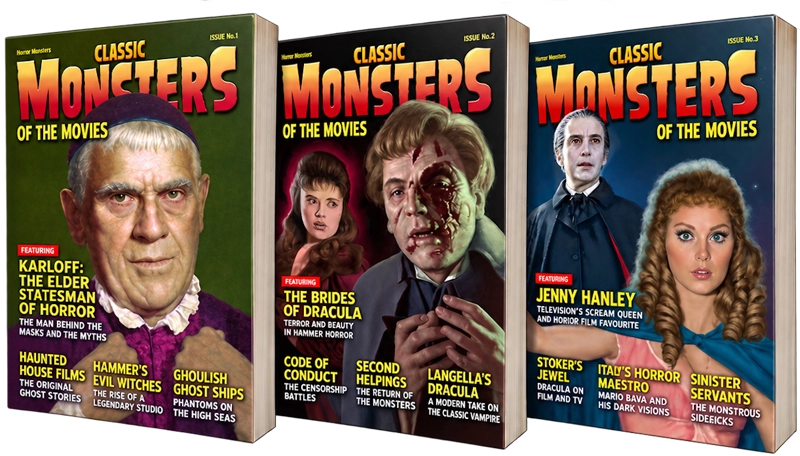
CLASSIC MONSTERS OF THE MOVIES magazine is a premium, award-winning British horror film magazine dedicated to vintage cinema, monster culture, and horror history. Since its launch in 2015 by creators Nigel Burton and Jamie Jones, CLASSIC MONSTERS has built up a highly passionate, global following among 'monster kids' and cinema historians. The magazine is known for its high-end production values, its elegant layout, its rare publicity stills painstakingly cleaned up and digitally restored, and its exceptional cover art. In fact, each edition is produced as a luxury collectors’ item.
The journalism, character profiles, film analyses, and biographies in CLASSIC MONSTERS are written by dedicated horror experts and industry professionals such as the actor and writer Jonathan Rigby and the Hollywood screenwriter John Logan (PENNY DREADFUL, GLADIATOR, SPECTRE, SKYFALL). This lavish and popular magazine is highly regarded among the horror community and has won the prestigious Rondo Hatton Classic Horror Award for Best Classic Magazine in 2024, 2025, and 2026.
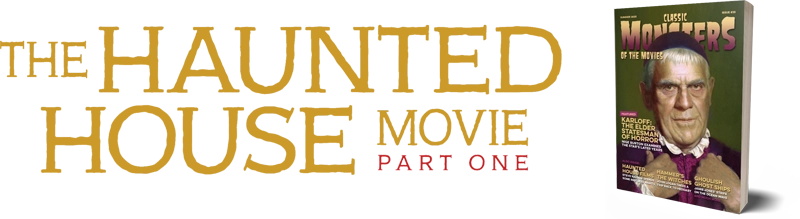
Steve Nallon joined the team of regular contributors to CLASSIC MONSTERS in 2025. Editor Nige Burton said of Steve's series of four articles on The Haunted House Movie, "As absorbing as it is authoritative... Trust me, you’ve never seen this particular subgenre explored to this level."
Back copies of CLASSIC MONSTERS OF THE MOVIES are available from the CLASSIC MONSTERS website link below. Steve’s The Haunted House Movie articles can be found in issues #35, #36, #37 and #38.
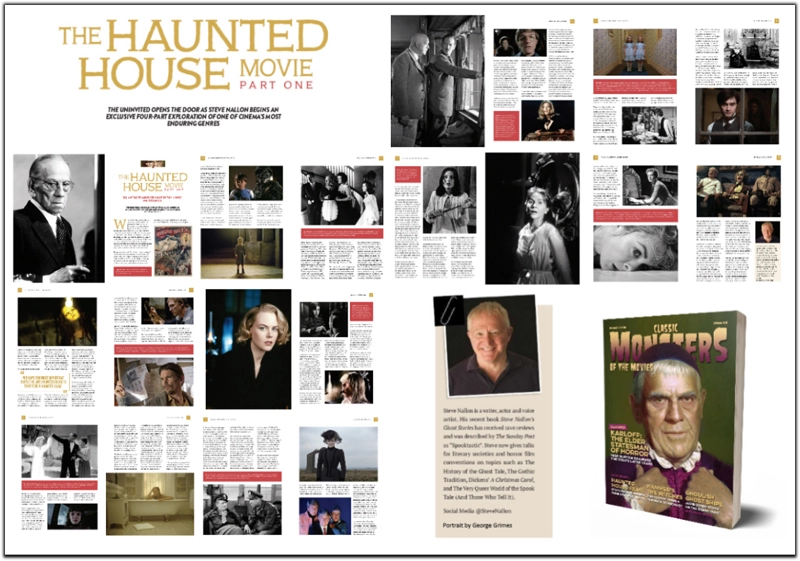
Part 1: The House, the Family and the Back Story – Summary of Article
When Bobby, the growling terrier dog, chased the squirrel into Windward House in the 1944 classic THE UNINVITED, he wasn’t only leading Ray Milland and Ruth Hussey into a spooky old mansion, but also kick-starting the genre of the haunted house movie. The key narrative drive in THE UNINVITED is the uncovering of a back story crime by the new residents, and Steve Nallon’s article suggests it’s this central investigative plot action that, in subsequent years, became the bedrock of many a haunted house movie. THE UNINVITED also has many of the tropes and story beats now familiar to the genre, such as the warning not to buy the house, a local gossip who provides the exposition, the comic servant who takes a dislike to the house, and the inevitable séance scene. In addition to these, there are visual and sensory moments, including the coming on of an eerie coldness and a strange smell, a hissing cat, candles being blown out, and a creepy old tree nearby. This first article, therefore, takes THE UNINVITED as the blueprint for the haunted house genre and shows how its seminal story beats and visual imagery can be traced through such movies as THE CHANGELING (1980), SINISTER (2012), EL ORFANATO (released as THE ORPHANAGE in 2007), STIR OF ECHOES (1999), WHAT LIES BENEATH (2000), and many more.
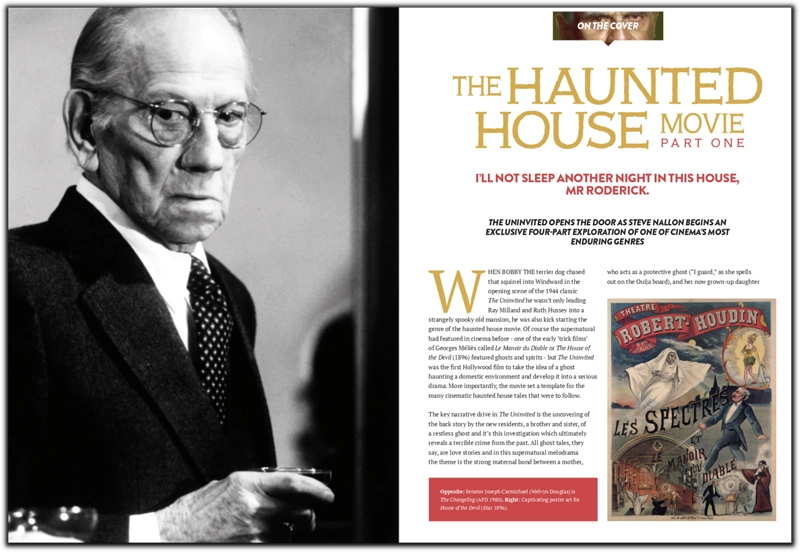
Steve’s article acknowledges that there are creepy house movies that don’t fit the back-story-crime-investigation scenario and supposed haunted houses that are revealed at the end not to have had a resident spook at all, plus ghost movies that better fit into a comedy or romance genre, rather than mystery tales. It should be said, too, that many movie hauntings don’t take place in actual houses, but in hotels, schools, or ships. That said, some of these do involve a family in some sort of domestic setting, and so Steve suggests, the definition of what a ‘haunted house movie’ is should perhaps be open and flexible. And it’s with this in mind that the article sets out to explore the haunted house movie genre – beginning with the nature of the house itself.
Haunted houses come in many shapes and sizes, as do their grounds and surroundings. Additionally, there’s how everything is shot and presented cinematically. Within the house itself, there are various rooms and spaces—notably attics, staircases, corridors, cellars, and bathrooms—that are key from a haunting perspective. Here, the article identifies the specific dramatic functions each plays in a haunted house story. Following this, Steve’s article considers the concept of the genius loci and the idea that the dwelling itself is a malevolent magnetic force or is possessed by needful spirits. Such spaces seem to worm their way into the minds of those who stay there, and so the psychological aspect of the haunted house movie is considered in depth. Arguably, though, the most important aspect of any haunted house is that it is a haunted home, for a major theme of the genre is the family under threat and the protection of children. And it’s in this context that the article moves on to consider the resident hauntees.
Steve points out that it’s the maternal figure who tends to be the most protective and watchful character (THE OTHERS, THE BABADOOK), whereas the paternal figure is more often than not a disruptive force, especially if he is experiencing a loss of status or a sense of failure (THE SHINING). Next there’s the crucial role that children play in haunted house tales. A classic trope is that it’s the child who is the only one, at least at first, who can see the ghost, though this sighting is usually dismissed by the parents as simply an overactive imagination. To the child, the supernatural manifestation may seem innocent enough, but its motive often becomes more sinister and some sort of abduction takes place. And that’s when the family crisis really kicks in.
Steve Nallon’s first article concludes by observing that the haunted house movie genre is able to explore psychological situations of family conflict, often in the context of a crime from the past impinging on the present. It is this aspect of such narratives, as well as the shocks and starts, that often makes the haunted house such an enduring and fascinating movie genre.
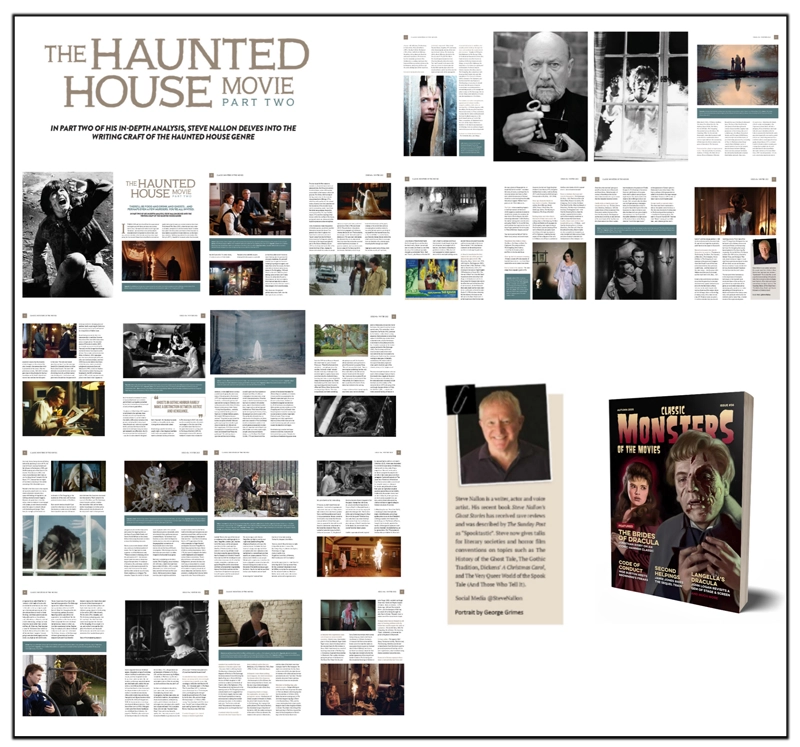
PART 2: The Story Craft of the Haunted House Movie – Summary of Article
Part two of Steve Nallon’s article on the haunted house movie genre begins by suggesting that a supernatural tale can be as speculative and imaginative as the writer wishes, but its story craft must work within its own logic and set out limitations. Further, the writer is free to make use of any story trope going, but ideally, conventions, narrative frameworks, and plot structures should be reinvented in some way. Another basic point is that the actions and choices of the characters should be as realistic as possible to human behaviour. Related to the credibility issue is the importance of keeping the tale as pacey as possible so that the audience doesn’t have too much thinking time to question the whys and wherefores. It’s also key that protagonists are given agency, or are at least made to push for answers, for it’s drive and strive that delivers forward motion in any drama. With these basic pointers established, Steve’s article moves on to look at the specific story craft elements of the haunted house movie genre.
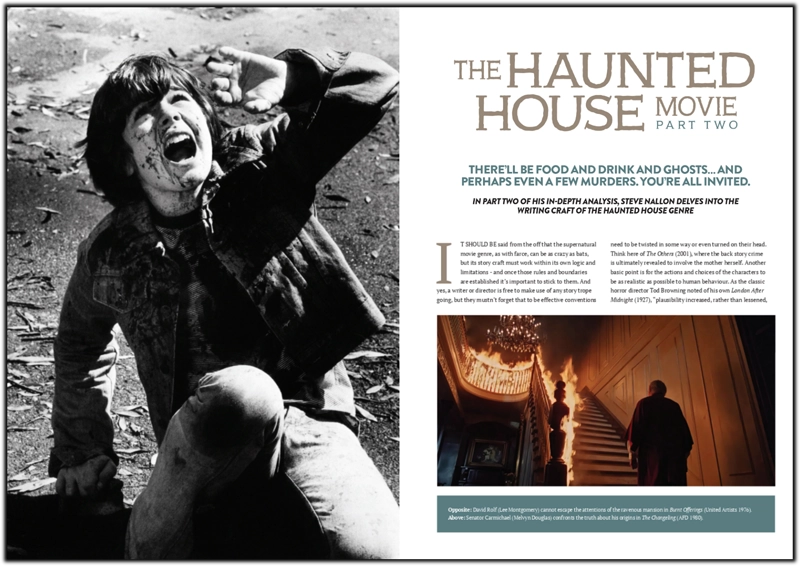
The concept of unity of place is discussed in relation to setting, boundaries, and the ‘pressure cooker’ atmosphere of a confined space. Unity of time is also considered, particularly a movie’s use of ‘real-time’ and ‘non-linear time’ — as is the importance of specific times of day (or usually night) for manifestations and the dramatic value of time deadlines.
As observed in the first article in the series, it’s often an investigation into a back story crime that is the central action. Consequently, the haunted house movie has much in common with another genre, namely the whodunnit. And it’s in this context that Steve’s article here considers the role of red herrings, misdirections, and foreshadowing in the workings of the story structure of the haunted house genre.
A story craft device that’s found in pretty much every scary movie is the false alarm scare – or the ‘Lewton Bus’, as it’s known to horror fans across the world. Steve’s article looks at a variety of false scare techniques and the ways filmmakers constantly strive to be as inventive as possible in order to avoid the cliché of the ‘cat scare’. In this context, there is also an analysis of what is known as the ‘jeopardy set-up scene’ (which usually occurs early in the movie), plus what contemporary filmmakers refer to as the ‘foreplay scare’ – the false scare that often launches the climactic action. This section of Steve’s story craft article then moves on to consider the importance of the dramatic relationships between conflicting characters, the nature of suspense, and the role of comic relief in haunted house narratives.
Writers can, of course, base their haunted house tales on established story frameworks. Here, then, Steve takes a detailed look at the use of the Gothic tale structure in the movie AND NOW THE SCREAMING STARTS, which is based on the novel FENGRIFFEN by David Case. There are also those tales where the kernel of the story originates from a real-life experience, and it’s in this context that the article considers David Lowery’s A GHOST STORY and Ari Aster’s HEREDITARY, as well as those movies which in some way or other make use of childhood angst.
Steve Nallon’s article concludes by looking at some of the long-established story tropes associated with the haunted house genre, including an interdiction warning; a recent trauma or tragedy that has enabled a character to become a ghost-seer; a strange but explainable incident, usually early in the story, that makes the protagonist uneasy; an injury of some sort; reluctant or barking dogs; noises blamed on old pipes; sleepwalking; a dream sequence where what is real and what isn’t becomes a blur; recovered memories; a savant character who explains the supernatural phenomenon; the sudden appearance of creepy-crawlies; a séance or Ouija board session; possession by a ghost or supernatural entity; decapitations; a cleansing climactic fire; and and finally, a coda suggesting a supernatural presence still remains. Then there are the visual, sensory, and auditory motifs often found in these films, such as shaking chandeliers; pensive hands on doorknobs or handles; doors or windows that open and close by themselves; strange smells or unusual stains; and a musical instrument that plays itself, usually a piano.
Part 3: The Cinematic Techniques of the Haunted House Movie – Summary of Article
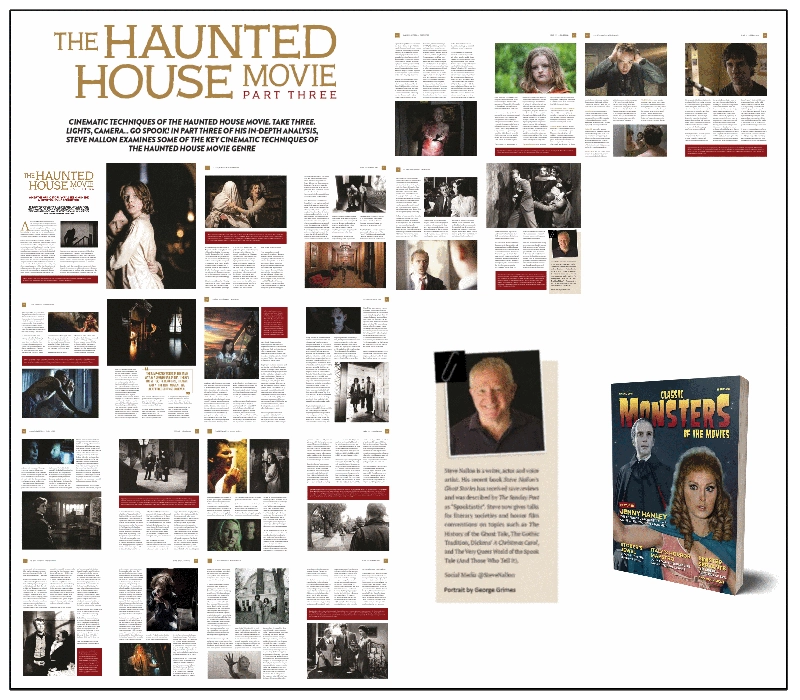
As the horror movie is primarily visual, you could say it’s the genre of the modern age that comes closest to the pure cinema of the silent era. And it’s with that thought in mind that Steve Nallon begins his third article on the haunted house movie genre, focusing on, one, how what we see on the screen is designed to serve the narrative, and, two, the methods and techniques film makers use to achieve this.
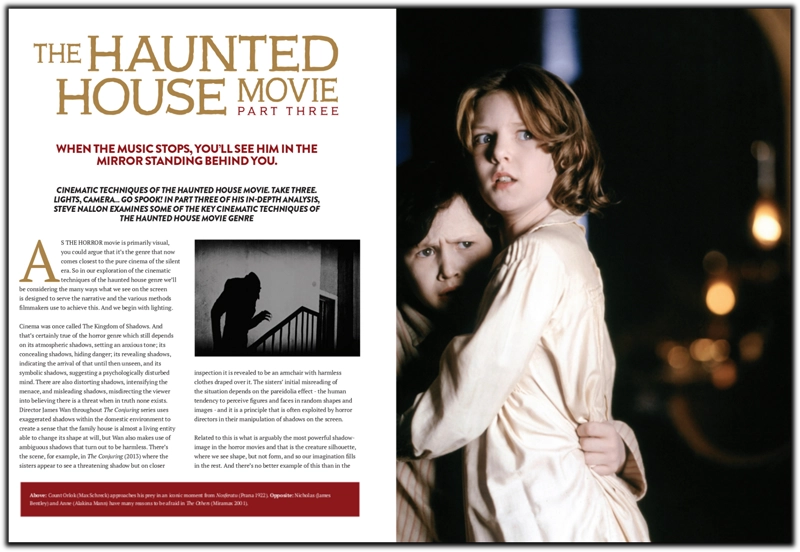
Steve’s article begins with a detailed analysis of the use of lighting and shadows, looking at the power of the creature silhouette, as well as light sources and contrasts – especially ‘chiaroscuro’ lighting. Following on from this, here’s an examination of camera placement and movement, camera angles, use of the ‘Dutch tilt’ and the camera/lens effect known as the ‘trombone shot’. Next, Steve considers the visual composition of the image itself and how it is photographed. Here the article examines aspects of framing and shot composition such as ‘rule-of-thirds’, ‘lead room’, use of negative space, unnatural symmetry, stillness at the ‘vanishing point’, as well as deep focus photography.
Another important visual aspect of any haunted house movie is how a ghost is represented on screen, and so there’s an analysis of how different filmmakers have achieved this and the way cinematic representation links to the central theme of the tale. In screenwriting there’s the well-known adage ‘Show, Don’t Tell’, but often the portrayal of the physical nature of the ghostly presence in a haunted house movie is more ‘Suggest, Don’t Show’, especially in psychological horror tales. And it’s in this context that Steve’s article considers the various cinematic options and visual techniques and devices that are available to filmmakers. Following on from this, there’s a look at the use of different lenses, plus what it is possible to do with the film or the digital shot material in post-production.
The importance of sound design in a haunted house movie shouldn’t be underestimated, as in horror, images don’t just come from what you see, but also from what you think is there based on what you hear. This section then considers audio levels, ‘infrasound’ or ‘black noise’, the sound design technique known as ‘hyper-Foley’, and the role of the musical sound track, including the use of popular songs.
Steve’s article next moves on to consider what you might call the nature of the ‘camera’s eye’, meaning whether what we are seeing is objective or subjective POV (Point of View), as well as what’s known as ‘ambiguous camera’. Linked to all this are inference edits, where the viewer is left to decide exactly what the connection is between certain shots. There’s also a delve into the history of subliminal editing in spooky movies.
Two visual techniques that movie directors are very fond of using are reflected images (be they in water, glass, or a mirror) and the frame-within-the-frame. Steve’s article considers examples of each. These techniques can be combined, and the re-adjustment of an inner mirror frame that causes a shock reaction is a popular scare effect. And this brings us to the question of the ‘jump-scare’ (or ‘startle reflex’, to use the term coined by psychologists). Steve’s article considers the structure of the jump-scare and its similarity to comedy. Following on from this, there’s a detailed look at some of the shockers that James Wan produces in THE CONJURING and a thorough analysis of how they work. These include the ‘Drop Surprise’, ‘Exit Frame Right’, ‘Return Frame Left’, ‘Negative Space’, the ‘Tilt-Up’, ‘Noises Off’, the ‘Cut Back’, and the ‘Hidden Face’. The key point with all these is that James Wan is very careful to vary the scare techniques and spread them evenly throughout his movie. In fact, filmmakers have a huge array of frighteners in their jump-scare arsenal, and Steve’s article continues with a look at scares such as characters unexpectedly crossing the frame, the leap toards camera that engulfs the frame, the snap blackout and so on.
Essentially, part three of Steve Nallon’s article on the haunted house movie genre examines cinematic style, which he defines as the manner in which a movie maker expresses their distinct creative vision, through mood, tone, and pace, with the aim of shaping how an audience will experience the story by the way it is cinematically presented. Of course, every haunted house movie director has their own style, but then comes the question: Can a movie have too much style? Being distinct is fine, but critics and detractors have argued that for some directors style often takes precedence over substance, and that their movies become ‘showy’ or that their films may work well enough as mechanical frighteners, but are ultimately clinical and emotionally vacuous. Whatever view is taken, it’s always worth repeating the old adage, ‘It’s not about the shot, but what the shot’s about.’ In other words, cinematic style and technique are pointless if their purpose doesn’t serve the narrative.
Part 4: How Writers Come up with Their Ideas, Why Audiences Enjoy Being Spooked, How the Haunted House Movie has Developed Since the Days of THE UNINVITED, and Where Might the Genre Go from Here – Summary of Article
The question writers are asked most often is: “Where do you get your ideas?” Steve Nallon considers how Stephen King addressed this issue in his book DANSE MACABRE, where King talks about ideas being forged in that halfway world between dreamy sleep and wakefulness. Then there are dreams themselves, and here the article offers an example from the screenwriter C. Robert Cargill, whose inspiration for his movie SINISTER came from a nightmare.
Steve then moves on to discuss the oft-quoted line that “bad writers borrow, good writers steal.” In this section, he looks at the way writers take actual story structures from myths and tales of the past, such as the ‘Weeping Woman’ (La Llorona) and ‘White Lady’ legends. And it’s in this context that the article explores the movies THE CURSE OF LA LLORONA (2019) and THE WOMAN IN BLACK (1989 and 2012). There is also a discussion in this part of the article about the Gothic romance influence on Del Toro’s EL ESPINAZO DEL DIABLO (THE DEVIL’S BACKBONE).
Next, Steve considers how the haunted house movie transcended itself in films such as THE CHANGELING, THE SHINING and THE INNOCENTS. There is as well a look at the way the haunted house can be transposed to other environments – such as in the movies DASHCAM, GHOST SHIP and EVENT HORIZON – and how a movie can be given depth and resonance by bringing in a psychological or political subtext. Examples of this are the heavy Freudian symbolism in HATCHET FOR THE HONEYMOON, and THE INNOCENTS, and the undercurrent of emotional scars from war in HIS HOUSE and UNDER THE SHADOW. A further way of reinventing the genre is to subvert its story tropes – for example, the ‘final girl’ trope and the way that role is ironically presented in SINISTER.
Following on from this, Steve looks at the idea of transmuting the very concept of the ‘haunted house’ narrative – for example, in the films ALIEN, THE THING, EX MACHINA, and GET OUT. Then there’s genre blending, as in movies like THE CAT AND THE CANARY, BEETLEJUICE, A HAUNTED HOUSE, THE CABIN IN THE WOODS, DEADSTREAM, and the Japanese cult classic HOUSE/HAUSU.
Steve’s article then considers the seminal influence of GHOSTWATCH, broadcast by the BBC on Halloween night in 1992, on the whole concept of fiction-as-reality in mockumentary and docudrama, with an in-depth analysis of Joel Anderson’s 2008 movie LAKE MUNGO and Ashley Thorpe’s 2017 BORLEY RECTORY.
There are many different types of innovation in the haunted house genre, so Steve next looks at A GHOST STORY (2017), where it’s the ghost who is essentially haunted by the living, at least in a psychological sense, and the movie PRESENCE (2025), where the entire tale is presented from a subjective camera, first-person POV (Point of View). An intriguing link between these very different movies is that both have a ghost that exists in non-linear time.
Most stories, it can be said, are built on an overarching philosophy of life. THE UNINVITED is a movie where a past crime is uncovered, wrongs are righted, and justice prevails. But not all modern filmmakers share such a neat and rosy philosophy, for many see the world as cruel and immutably savage. And so here Steve’s article discusses the nature of the slasher movie, with particular reference to Freddy Krueger in A NIGHTMARE ON ELM STREET. Wes Craven said that “you don’t enter the theatre and pay your money to be afraid. You enter the theatre and pay your money to have the fears that are already in you when you go into a theatre dealt with and put into a narrative.” Death is our ultimate fear, and, as with Freddy, it cannot be defeated. And here Steve suggests that part of the appeal of the pure horror haunted house genre is this deep-rooted existentialism.
It’s suggested that many messages lurk inside the horror genre. Stephen King in DANSE MACABRE argues that “a good horror story is one that functions on a symbolic level, using fictional (and sometimes supernatural) events to help us understand our own deepest fears”. And for King these include not just personal fears, but the shared fears of the society in which we live – for all societies have their “national phobic pressure points” that change over time. And here Steve Nallon goes through the many movies considered in the series and the various themes they have explored. One is the recorded medium itself and, specifically, our watching and liking of horror movies. Here Steve examines how the graphic home movies of killings are presented in SINISTER. There is one very telling shot, for example, with a reflection in the glass of Ellison’s spectacles of the flickering image from one of the reels of a knife slitting a throat, which gives the impression that the violence Ellison is witnessing is being stamped and engrained into his mind. And from this, Steve looks at various psychological theories around the appeal of horror tales in studies such as Noël Carroll’s THE PHILOSOPHY OF HORROR and Bruno Bettleheim's THE USES OF ENCHANTMENT.
Executives are aware that although there is an automatic audience for any haunted house film, the horror community knows their stuff. To gain a reputation a movie must not only do what it needs to exceptionally well, but it must also have, as we have seen, some degree of originality and freshness. The article and the series then conclude by asking where the haunted house movie genre might go next. Ghosts mirror their times, and we live in an age where the modern generation is encouraged to confront the politics of the past; so, should we expect to see more stories where ghosts give voice to those who had no voice, or who have been unrepresented in the history books. And maybe more stories on modern urban myths or tales told in non-linear time? Whatever the case, as George A. Romero used to say at horror conventions, and as Mike Enslin says to his audience at his book signing in Stephen King’s 1408... "Stay scared."