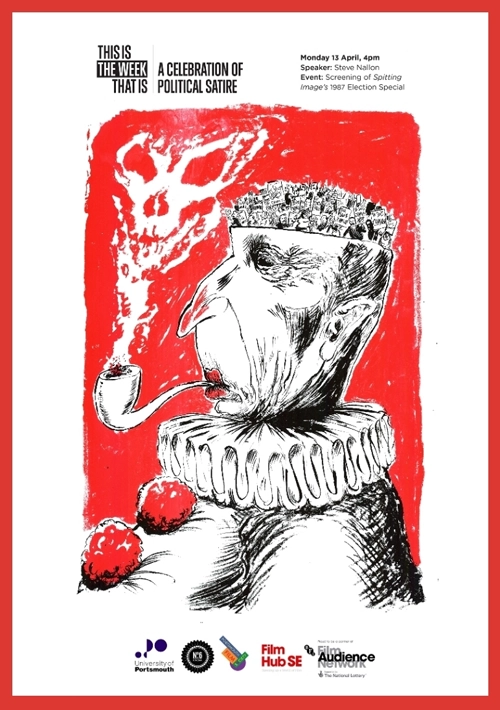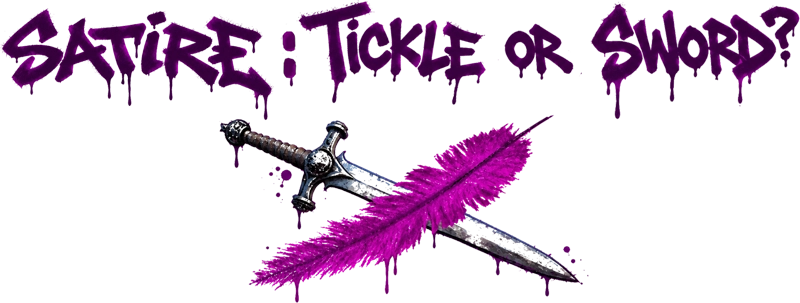
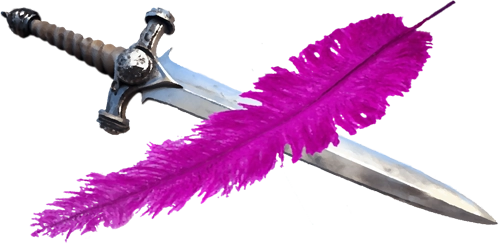
Steve Nallon’s talk ‘Satire: Tickle or Sword?’ addresses the important roles satire plays in holding power to account and pushing back against societal censorship. The lecture is a journey across the history of satire, right through to the present day. There’s a look at the core moral viewpoint of a satire; an examination of the different forms, techniques, and methods of satire; and an exploration of the psychological nature of the satirist. Running throughout the talk are the questions: What is the purpose of satire? How effective is it? Is satire ultimately more tickle than sword?
The lecture opens with an examination of the history, origins, and etymology of satire, beginning with the Greek theatre’s skittish plays called ‘satyrs’, and moving through to Alexander Pope (“O sacred weapon! left for Truth’s defence, / Sole Dread of Folly, Vice, and Insolence!”), and Jonathan Swift (“Satire is a sort of glass wherein beholders go generally to discover everyone’s face but their own”).
Next, the talk considers the importance of a moral viewpoint (or lack of it) in satire. There’s a detailed look, as well, at the methods and techniques of satire, including the role of mockery and ridicule, anthropomorphism, back-to-front thinking, surrealism and the outright weird, the principle of parallel worlds, musical satires, so-called black comedy, violence and misrule, the Commedia dell’arte tradition, plus travesty and burlesque. The lecture also considers the form and tradition known as Menippean satire, and following on from that the Horatian and Juvenalian styles.
Steve then asks, ‘What makes a satirist a satirist?’ and considers some of the social and psychological issues at play. The talk also addresses the case against the satirist – namely, that satirists know what they are against, but what are they for? Swift wrote, with regard to his own satire, “Yet malice was never his aim; / He lashed the vice, but spared the name.” In footballing terms, he went for the ball, not the man. But can this always be said of recent satire? Steve’s presentation concludes by looking at the platforms for satire today in a world where, to quote Marshall McLuhan “The medium is the message” – think here of YouTube, X, and Instagram. Then there’s Tom Lehrer’s oft-quoted remark that “political satire became obsolete when Henry Kissinger was awarded the Nobel Peace Prize.” Has our modern social and political landscape turned so insanely absurd that it has become its own satire?
Steve Nallon’s talk ‘Satire: Tickle or Sword?’ is based on the keynote speech he gave at a conference at Portsmouth University celebrating political satire.