Summary: Steve Nallon’s talk ‘Young Adult Fiction – Change and Discovery at the Story Funfair’ considers three key areas of YA fantasy fiction, namely, maturation, learning, and entertainment. The talk looks, too, at where creative ideas come from and the practical process of writing.
Year Groups: The talk is suitable for year groups KS3, KS4, and KS5.
Main Takeaways: The first is how the ‘otherness’ of fantasy fiction has, throughout history, played a crucial part in shaping the psychology of young adults, and the second is the way ideas often originate in real-life incidents and how pupils can, from such experiences, create their own imaginative fiction.
Steve begins the talk by asking pupils to think of an odd event they witnessed or unusual behaviour they observed. There is then an assurance that later on in the talk the class will take some of these odd incidents and explore how they might be creatively turned into a fantasy fiction tale.
At this developing stage in the life of the young teenager, there isn’t much that they can change about the circumstances of their everyday life – whether at school, at home, or even socially. However, what a child can do is begin to make choices and decisions about who they wish to be, and fantasy fiction can play its part in change and development. Tales of awakening, transitioning, and maturation have been around for centuries. Many often involve a journey to a threatening world, and it’s here, away from social rules and restrictions, that characters are forced to explore the full spectrum of their capabilities. It’s by facing up to the challenges of such dark worlds that protagonists find out who they are – and this introduces us to one of the key ideas in Young Adult fiction: ‘becoming’. But how is change brought about within the tale itself?
Universal folklore and mythology have a shared path, and this is true as well for much coming-of-age fantasy fiction. In a typical maturation story, a young person discovers within themselves or is given or offered a special power or artefact. It is then revealed to the Hero (here used as a gender neutral term) that this gift, be it internal or external, is desired by a Dark Force that is prepared to kill the Hero in order to possess it. At first, the Hero is often reluctant to take on the responsibility (the ‘Refusal of the Call’) but circumstances or events inevitably make the challenge necessary or unavoidable.
Usually early on in the tale, the Hero meets a Mentor figure who offers guidance, and they might also encounter friendly allies. At this stage in the tale, the Hero may well be gifted talismans or magical tokens that could be useful on the adventure. These items are sometimes known in story theory as the ‘Donor’s Gift’.
The Hero usually faces or is given some sort of task or assignment, and this often involves a journey to what writers call the ‘Special World’. In certain stories, this journey is made possible by way of a magic portal or threshold, but if not, there is usually some sort of symbolic crossing over, perhaps by way of a bridge, river, or cave entrance, to mark the physical beginning of the expedition.
In this new, unfamiliar, and dangerous environment, the Hero will encounter obstacles and there’ll be trials to overcome. The Mentor figure and Allies may be there to help, but in the end, the Hero must confront that Dark Force on their own, in battle, be it mental or physical. At this stage in the story, the Hero often goes through a kind of death experience, often at the hands of the seemingly victorious Dark Force. However, by finding a strength from within, the Hero ultimately triumphs. And it’s this rite-of-passage victory, and the discovery of that inner potency, that takes the Hero on the next step towards adulthood.
Does all this sound familiar? Well, you can find this basic structure with variations throughout fantasy fiction, in stories featuring characters called Luke Skywalker, Dorothy Gale, Katniss Everdeen, Aladdin, Frodo Baggins, Harry Potter, Lyra Belacqua, and indeed, the Hero of SWIDGERS, William Arthur. In each case, but in individual ways, the boundaries of what the reluctant child believes themselves capable of are challenged, or even pushed to an extreme, in order that the full rainbow spectrum of their potential can be accepted and embraced. Such archetypical coming-of-age tales can be found across the globe and across history, and so, not surprisingly, many theories have been put forward to explain this recurring structure.
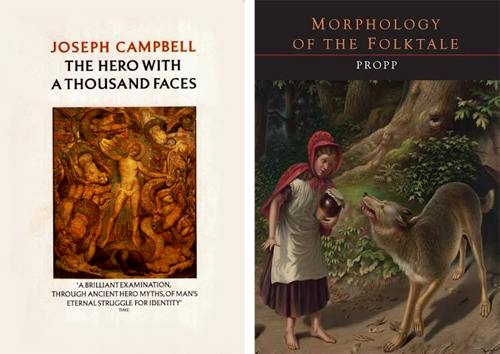
A well-known explanation comes from the psychologist Carl Jung, who argued that human beings share what he called a ‘collective unconscious’, which is populated by universal symbols and archetypes, including The Shadow (the Dark Force) and The Wise Man or Great Mother (The Mentor). These resonate with all human beings because, he suggests, we are telling each other essentially the One Story: The Human Story. Other thinkers in this area of story theory are Joseph Campbell, author of THE HERO WITH A THOUSAND FACES, who gave us the terms ‘Special World’ and ‘Refusal of the Call’. Similarly, the Russian folklorist Vladimir Propp, who wrote the book MORPHOLOGY OF THE FOLKTALE, formulated the terms ‘Donor’s Gift’, ‘False Hero’ and ‘Dispatcher’ (the character who sends the Hero on their mission). Incidentally, YA fiction is not the only type of story to use this basic structure. It’s also a narrative pattern that’s there in the James Bond 007 adventures.
Pupils attending the talk are then asked if they’ve ever pulled someone back when a car was about to hit them, or pushed them away from a path with falling debris. If so, says Steve, they could be a ‘Swidger’ like William Arthur in the time adventure book series THE SWIDGERS. This leads to a discussion around the way writers often use their own life experience as a starting point for imaginative fiction.
In Steve’s case, it was an incident where, after a brief delay talking to a stranger, he came home slightly later than he intended but in doing so just missed a heavy slate tile that fell from his roof. Had it not been for that delay, he very likely would have been killed. That seemingly chance encounter that saved him from a potentially fatal incident stayed with Steve, and from this experience came the idea of the ‘Swidger’ – one who can sense future disasters and so acts to alter a person’s timeline to prevent injury. That was the initial concept, and from that developed the specific nature of our young Swidger, the setting, the dark force that would pursue him, and the central plot action. For example, Steve decided that William Arthur, as a cosmic being, would be unable to tell an untruth or do any harm or act violently against another. His age is unspecified in the book, but it is clearly suggested he is approaching puberty. As mentioned, it’s not unusual for such a coming-of-age character to have a mentor figure. Mentor, Steve explains, was the name of the man in Homer’s ODYSSEY who took Telemachus, the young son of Odysseus, under his wing. Except that Mentor wasn’t a man at all; ‘he’ was the goddess Athena in disguise. Anyway, in THE SWIDGERS William’s mentor is based on Steve’s Yorkshire grandmother, a tough-love northern matriarch, born in 1906, six years before the ‘RMS Titanic’ sank. ‘Granny’, as she calls herself in the story, is no-nonsense and strong-willed but also very funny. She sees that William is full of self-doubt but recognises as well his curiosity and insightful way of thinking. It’s revealed that William Arthur is an orphan, as many are in such stories (think here of Harry, Luke, and Dorothy), and in meeting Granny, William becomes a rescued child, though some element of trauma from being alone and unwanted remains with him.
Throughout the first book, THE TIME THAT NEVER WAS, our hero grows in confidence, challenges adult authority, and moves from self-doubt to self-reliance. Book two, THE TIME THEY SAVED TOMORROW, continues the adventure. Without giving too much away, Granny and William begin to act more and more in partnership, with mutual respect for each other’s strengths.
Next, the talk returns to the question set out earlier concerning unusual behaviour and strange incidents. For example, in a past class, someone saw a woman on a crowded street walking along constantly looking down at the pavement and never ahead. Was the woman simply looking for money? If so, that could become a story of survival. However, there’s always the possibility of a far more fantastical reason. Could it be, for example, that she’s following a dog that’s invisible to everyone but her? If so, where’s the dog leading her? The point here is that every incident in life can be a potential kernel or scenario for a story. Steve then takes some real-life examples offered up by those in the class, and, with suggestions from all round the group, develops ideas and plots for a fantasy adventure.
At the conclusion of this interactive section of the class, Steve offers some examples of unusual real-life occurrences that led well-known novelists to write their fantasy stories:
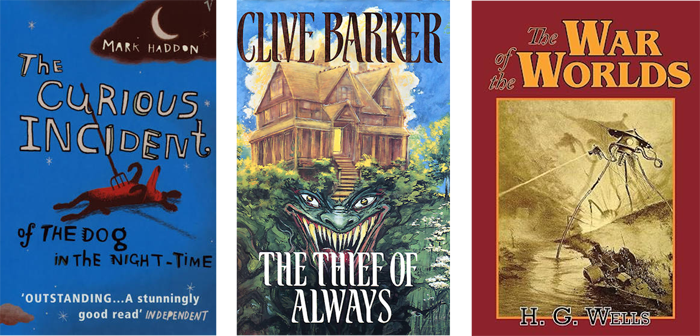
THE CURIOUS INCIDENT OF THE DOG IN THE NIGHT-TIME by Mark Haddon. The sight of a neighbour’s dog that had been brutally killed and impaled with a garden fork right in the middle of the lawn. The sadness and strangeness of this disturbing image served as the catalyst for the opening scene of the tale and title of the novel.
THE THIEF OF ALWAYS by Clive Barker. A meticulously maintained mansion in a well-to-do neighbourhood that had an incredibly eerie, artificial atmosphere, with a strange, unseasonal air. This uncanny observation became the inspiration for ‘Holiday House’ into which children are lured and where each day features all four seasons, endless sweeties, and Christmas every evening – only it’s real purpose is as a trap to feed on their souls.
THE WAR OF THE WORLDS by H.G. Wells. The reading of a factual scientific report in the magazine ‘Nature’ in 1890s by a French astronomer detailing a ‘strange light’ blinking inexplicably on the surface of Mars. Wells took this cosmic anomaly (‘I saw it. A reddish flash at the edge, the slightest projection of the outline just as the chronometer struck midnight’) and turned it into an invasion of Earth (‘An enormous hole had been made by the impact of the projectile, and the sand and gravel had been flung violently in every direction over the heath, forming heaps visible a mile and a half away’). As a political writer, Wells used the story as a way of critiquing British colonialism.
Children’s stories with characters inspired by real life people include ALICE’S ADVENTURES IN WONDERLAND by Lewis Carroll (inspired by Alice Liddell, the daughter of Henry George Liddell, the Dean of Christ Church, Oxford, and a family friend of Carroll’s); WINNIE-THE-POOH by A. A. Milne (based on Milne’s own son, Christopher Robin Milne, and his collection of stuffed animals); PETER PAN by J.M. Barrie (inspired by the Llewelyn Davies boys, a group of brothers Barrie met while walking his dog in London’s Kensington Gardens); and WHERE THE WILD THINGS ARE by Maurice Sendak (the monsters were affectionate caricatures of Sendak’s own eccentric European immigrant relatives who often visited his childhood home). The point is that it’s the instinct of the writer to take life experiences and mould them into stories.
Moving on from this, Steve next considers the concept of discovery in YA fiction. Any good book should introduce us to new subjects and ideas, but the key principle with YA fiction is that discovery should be active, not passive. Learning here isn’t about details of history, but rather a fresh understanding that comes through the action of the tale. For example, the protagonist discovers that a key character isn’t who they seem, or that their entire world view has been completely false. What this means is that the reader, as with the hero, has to reassess all that came before. A massive reevaluation is needed in order to piece together an objective truth – and crucially, that requires a new way of thinking. And this is one of the reasons why mystery stories and false identity tales are so hugely popular with young adult readers. Discovery isn’t therefore just about finding a treasure, but rather a mental restructuring of all the events of the tale.
Following on from this point, Steve introduces the idea of ‘reader-response theory’, meaning in general terms the range of experiences a reader might have when immersed in the world of a fantasy novel. For example, there’s the idea of ‘walking in the shoes of others’, where the reader projects themselves into the experiences, actions, and thoughts of one of the characters, usually the protagonist. This is achieved by ‘embodied simulation’ where our brains, via our ‘mirror neurons’, give us an internal echo of what’s happening to a character. Another concept is the ‘suture’ theory of reading fiction, where stylistic choices, such as short, snappy sentences, use of the historical present, and the subjective voice, ‘stitch us’, as it were, into the immediacy of scene so that we feel as if we are with the characters ourselves. Related to these theories is narrative empathy, which refers to the way a reader becomes absorbed by the tale and how that can lead to the understanding of another’s truth. It should be said as well that the plot itself, with its difficult choices and moral dilemmas, also allows readers to navigate emotional conflicts. Sometimes a story can help with personal healing, for psychologists recognise that the so-called ‘safe space’ of fiction allows a developing child to deal with their own past traumas and inner turmoil. Essentially, what reader-response theory argues is that a fictional text is not a passive object; rather, it is created through the active interplay and psychological experience of the reader.
But let’s not get carried away with all this psychology, its deeper meanings, and complex functions because the entertainment factor of a YA novel is essential too. What we’re talking about here is what you might call the ‘story funfair’ and the excitement of those thrills, bumps, and twists. And if there aren’t enough of these, the reader isn’t going to stay with the novel or even care about what happens next.
Steve next considers the huge impact the commercial success of the ‘Harry Potter’ novels had on Young Adult fiction. Publishing houses are still trying to secure the ‘next Harry Potter’, and as a result, YA fantasy has become very prescriptive concerning the way stories must be told and presented. Steve pushes back against this restrictive way of thinking, but nevertheless suggests that some basic advice might help pupils in their own creative writing.
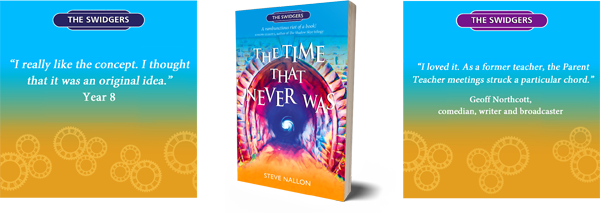
First, consider character. If your hero is ‘this’ (whatever ‘this’ is), the plot action should take that character to the opposite of ‘this’ (‘self-doubt’ to ‘self-reliance’ in the case of William Arthur). And if you think in terms of ‘this’ to its opposite, your story will always have a clear trajectory to an end point. A popular piece of advice often offered by writers is to make the challenges faced by your lead character as difficult and as demanding as you can. However, as Steve points out, this works best if those challenges are directly related to the particular nature of your protagonist. In Steve’s YA novels, because Swidgers are cosmic beings, they are incapable of lying and cannot ever be violent – what this means is that William is forced to come up with ingenious ways of getting himself out of scrapes or dangerous situations.
As for the other characters in your story, it’s useful to remember that we are all players in someone else’s tale. Yes, you are the hero of your own life, but merely a secondary or even walk-on character in those of other people. So the advice here is to know the story inside out from everyone’s perspective. As for the way characters talk, some practical advice is to speak aloud in different voices and, if you do that, the speech patterns and syntax will naturally come out differently.
A second basic point when putting together a fantasy tale is to set out what your rules are before writing your story. You can invent any story world you like, and your characters should be able to have any kind of existence you choose, but, once these are decided, it’s crucial to stick to them and be consistent. THE SWIDGERS is a time-travelling tale and so, Steve explains, he had to create the tale’s rules for time travel and how that would be possible well before writing began.
Related to the issue of preparation is the consideration of how the narrative is to be presented or told. Should it be written in third person narration or first person narration? Past tense or present tense, or a mixture of past and occasionally historical present? Again, these obviously need to be answered before a word is put to paper. Following on from that is the issue of style. Steve’s attitude is that you shouldn’t really be aware of or conscious of the writing as you read it. Ideally it should just flow. The style, incidentally, of THE SWIDGERS has been said to be cinematic, and this came about because Steve saw what was happening in the story in his head and put on paper how that action would be perceived through the eyes of young William. Anyway, some simple guidelines on style are: never use a word which isn’t absolutely necessary and don’t let the choice of words or expressions draw attention to themselves. Try not to start a paragraph or a sentence with the same word as the previous one. In fact, avoid any accidental word repeats, especially if the same word is used with two different meanings. That said, there is a rhetorical device called ‘antanaclasis’, where you intentionally repeat a word but it means something different the second time (“If you aren’t fired with enthusiasm, you will be fired with enthusiasm”). Another is ‘syllepsis’, where one single word (usually a verb) governs two or more other parts of a sentence but its meaning shifts between them (“She blew my nose and then she blew my mind.” — from The Rolling Stones hit song ‘Honky Tonk Women’). As Granny says in THE SWIDGERS, “Rules are like pie-crusts – they’re meant to be broken.”
A final issue if you’re writing a mystery story is that there’s always a balance to be had between revealing too little, which might leave the reader frustrated, and revealing too much, which would result in little or no suspense. As Wilkie Collins said, “Make ’em, make ’em cry, and then make ’em... wait.”
Steve ends by saying that ultimately all any individual writer can do is say, ‘This is the way I do it.’ Advice is useful, but everyone is different, and not all ways of working will be suitable for every storyteller. On a practical note, some writers prefer to work in the mornings, some late at night. There are those writers who insist on producing a specific number of words per day; others prefer set hours with no word target. Some writers use longhand, some a keyboard, and there are even those who dictate their narrative in software that then produces a written text. Certain types of writers finish the whole book before attempting any rewrite, while others do rewrites as they go along. Everyone has their own system. There are no hard and fast rules to writing – and this applies to the creative process too.
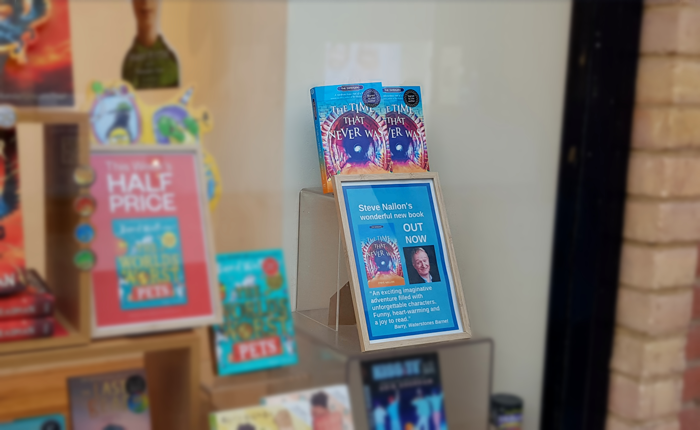
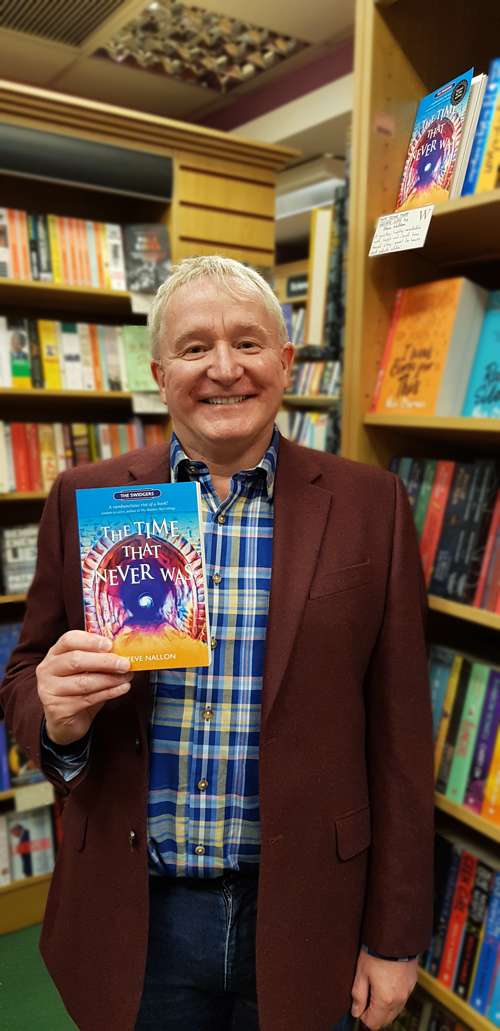
Steve Nallon’s Teacher’s Guide: A Colour-Coded Annotation of THE TIME THAT NEVER WAS offers a fascinating insight into the technique and craft of writing at the most detailed level. Writers are constantly balancing between character, exposition, plot, and action, all the time making decisions about the choice of words, metaphors, and the tale’s overall narrative design. The annotated analysis of the first two chapters of THE TIME THAT NEVER WAS takes you through the options by means of colour coding individual sections, passages, and lines to highlight the different aspects of storytelling.
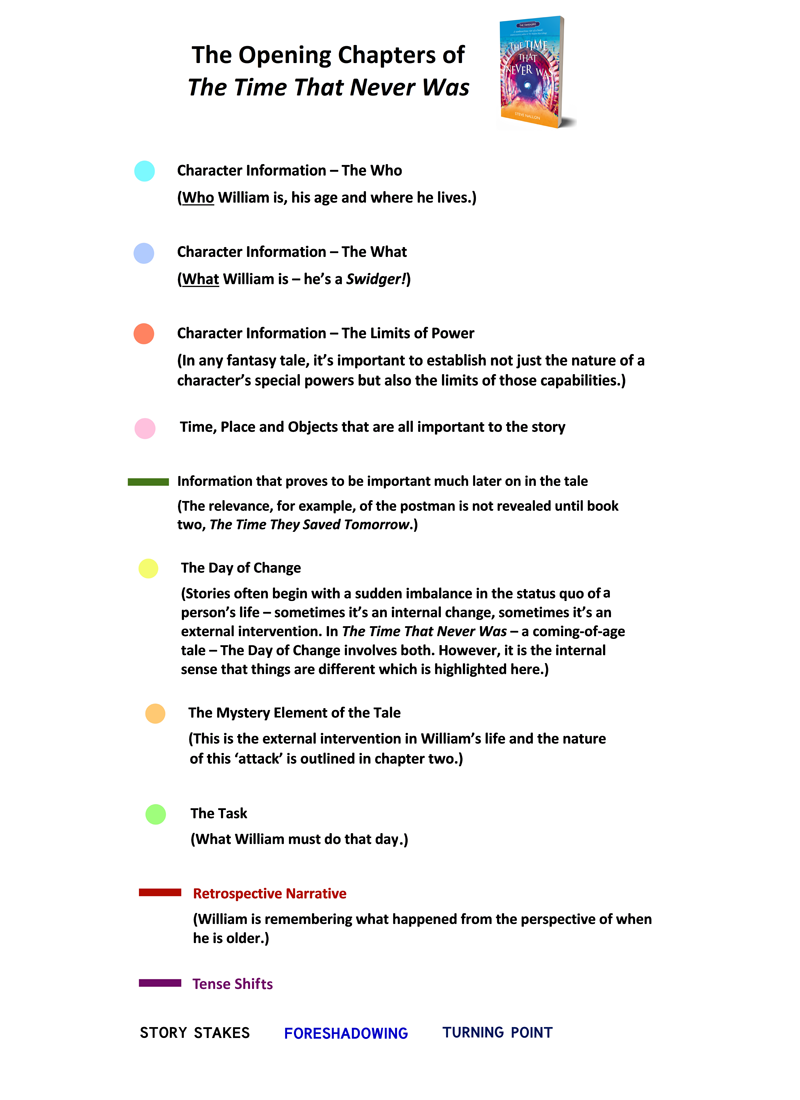
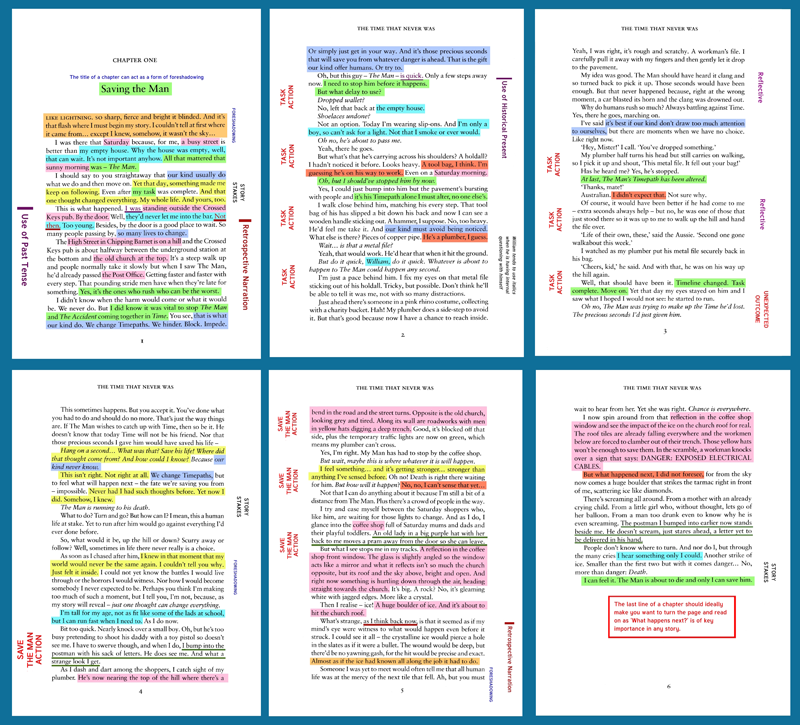
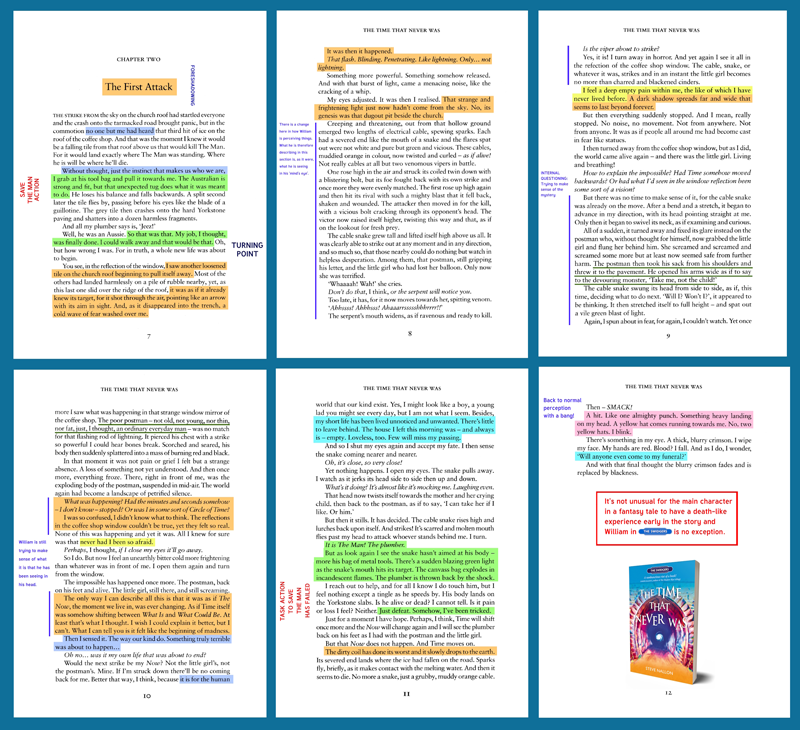
The Colour-Coded Annotations as Individual PDFs
To avoid information overload, the annotations have been divided into separate PDF files, all of which are downloadable below. There are PDFs covering exposition; task, action, and mystery; and narrative technique. There is also a complete colour-coded annotation with all techniques highlighted. In addition, there’s a PDF of the first two chapters with annotations, and this is for class activities and assignments.
Exposition – Character details, who and what William is, as well as essential story information about place, time, and setting. Also colour coded in this PDF is that information which does not seem immediately essential, but will prove crucial later in the tale.

Task, Action, and Mystery – The specific task action that William is undertaking as we join the story, and the mystery element of the tale. In addition, there are several occurrences that have never happened before, all indicating that this is a ‘Day of Change’ for William.
Narrative Technique – Foreshadowing, tense shifts, the historial present, and retrospective narration. Story stakes and important turning points are also featured in this annotation.
The First Two Chapters Fully Annotated
The First Two Chapters Without Annotations